Mirrorless: A viable option for wildlife photography?

I think as photographers we all have a tendency to desire the latest and greatest technology be it camera bodies or lenses, or the next best gadget that we think will make our lives easier or our photography better.
There is no substitute in my mind for the art of craft. Learning your craft behind the camera and learning from experience - the good and the bad. When it comes good we are ecstatic, when it goes bad we all feel a huge amount of frustration. For the later, I think we can all become better photographers if we temper the frustration and look at each failure as an opportunity to learn and get better. For every image I post publicly from which I get fantastic feedback, there are at least another 4 images within that same sequence that I blew. I'm sure this will be the subject of another blog post in the future...
There's no doubt that having good equipment will help produce better images. Part of that comes down to making the right choices, but it also comes down to the fit between photographer and the technology. Let's not hide from the stark facts here - if you want to get into wildlife photography in a serious manner, you will need to make some serious investments. That's not to say that you cannot get into wildlife photography using compacts or bridge camera systems. You can. And I am the first to advocate that its all about how you use the tool, the camera, to get the images, and not the camera itself. Indeed I never leave home for a shoot without a small compact camera with a "superzoom" lens, and you wouldn't believe how many times I've turned to that camera for an opportunity over my DSLR.
Looking at the likes of Canon and Nikon with their DSLR ranges, both these brands have a myriad of choices from beginner through to professional. You pay your money you take your choice. But we all know that the technology in the bodies can come and go quiet rapidly. Whereas lenses tend to stick around a lot longer, before they are update. This is why many a pro will advise to look at the glass as the investment first, rather than the DSLR body. Wise words...
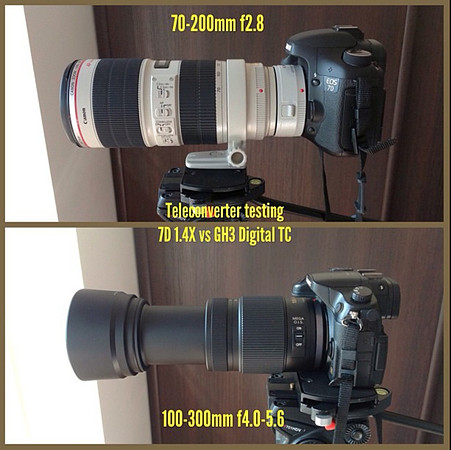
Lenses of choice for the pro wildlife photographer are typically fixed focal lengths of 300/400/600mm. These lenses are seriously expensive. They come in anything in between £3000-9000. The price of a family car in some cases. There is no doubt in my mind that to be able to get good captures in the field you need 300-400mm focal length as a minimum. A more cost effective option would be to look at teleconverters, such as Canon's 1.4X or 2X and combine these with a general all round lens such as the Canon L 70-200 f2.8 IS USM. On a full frame body this extends to 280mm with a 1.4X teleconverter stopping to f4, and 400mm with the 2X teleconverter stopping to f5.6. To the purest, they would argue that teleconverters degrade the image and you loose both f-stops and autofocus speed. Personally I think that the 1.4X teleconverter is a decent and affordable compromise. My current set up is a 1.4X teleconverter with the 70-200mm lens, and as I shoot with an APS-C body (the Canon 7D), I get a maximum focal length equivalent of 450mm at f4. More than enough in my opinion...and shooting in the fantastic light of Africa, you won't loose sleep about the f4.
But is there a more inexpensive way to get into wildlife photography and achieve those long focal lengths required?
The answer is "yes"....but there is a "but"...
The answer comes in the form of mirrorless systems. These are manufactured by the likes of Panasonic, Olympus (who use the micro four thirds system) and Sony (who use their own E mount lenses). For the purposes of this blog I am going to talk about the Panasonic system of mirrorless cameras at the high end, the Panasonic GH3.
I bought the GH3 last year when it was launched mainly for video based on the excellent reputation of its predecessor the GH2. But this year I have taken it on two trips to Sabi Sands, South Africa. Its primary purpose was to make "Behind the scenes" type movies of the safaris I was shooting. And for this purpose it worked very well. On the first trip in May, I had two lenses, these are the 12-35mm f2.8 and the 35-100mm f2.8. With micro four thirds, due to the sensor, you have a crop factor of 2X, therefore all the lenses have to be doubled to get the equivalent full frame focal length. So with these two lenses I had a range of 24-200mm both at a constant aperture of f2.8. These lenses are not cheap, but they are Panasonics premium lenses and I am very happy with them for both stills and video. They deliver fantastically sharp results.
Now on the May trip, I discovered that despite the 2X crop factor, at 100mm, I didn't have enough focal length on some sightings. I decided to use the GH3's 2X digital zoom feature. I first did this in video mode. The GH3 has a super OLED 614,000 dot touch screen. When I viewed the video back using the 2X digital zoom feature to my eye I saw no degradation in the image. It was only back in post when I started to edit the footage that I saw that there was degradation in the quality. That was a disappointment. But because I'd been fooled by the OLED, I decided to give things a try in stills mode...with the same results. But only visible again when I got back home and imported my images in to Lightroom. It was a tough lesson learnt about digital zoom features on cameras.
So between that trip in May and my next trip in September I decided to buy another lens for the GH3. I bought the 100-300mm f4.0-5.6 OIS lens. It's an image stabilised 200-600mm equivalent zoom. And I managed to pick one up in the summer sale for €420! Prior to my trip I did some side by side comparisons with my Canon 7D to make sure I was comfortable with the lens. I researched other users experiences online to make sure I was not going to get any nasty surprises when I was out using it. Despite all my preparations I was very frustrated with this lens, both in the field and with the results.
The main issue I had with this lens was focus. Despite the GH3 having many different focus modes, this lens had huge issues tracking focus of an object. It was the worst when at it largest focal length of 300mm. Even using the focus assist mode in manual focus which zooms in to the subject to allow you to get pinpoint focus was a failure. I realised that at 300mm the lens was just soft. I managed to get away with this using it for video as I could add sharpening in post. But for stills, any long lens work I was trying was just problematic. This is far from ideal when you may have limited time on any game or wildlife sighting. You need the camera to lock in on focus and be pin sharp within seconds. I just could not get this lens to perform as the other lenses I had for the camera.
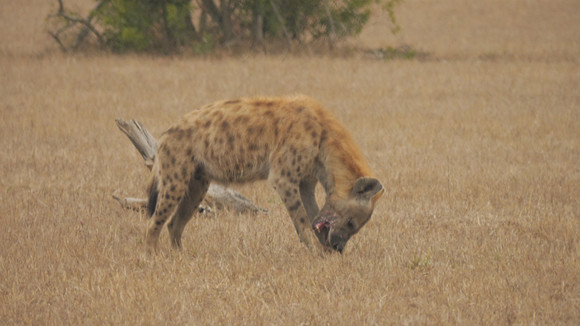
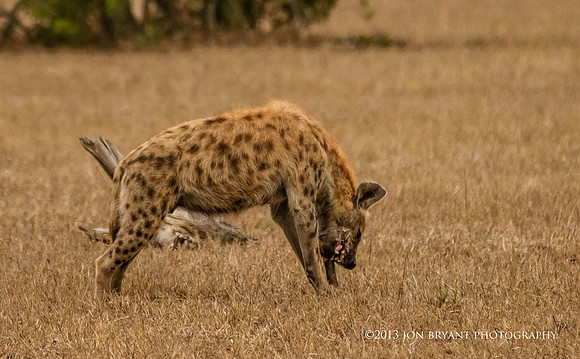
This is a shot of a hyena eating a bone. This was in an open area, and the hyena was about 100 meters away. The camera and lens were on a monopod with IS off on the lens. I used auto focus to lock on the subject. You see the image is horribly soft. Viewing the image on the OLED and zooming in, I could see this. I switched to my Canon 7D and shot this image instead:
When I finally did get it to work, it was mainly on sightings or animals resting up, where I was fortunate enough to finally get the lens to focus correctly. Below you see two shots with this lens of Zebra. We were very far from these Zebra, my guess would be 200 meters or so. The first shot was using auto focus - a complete fail. The second was shot in manual focus mode. I was lucky enough that the Zebra's didn't move:
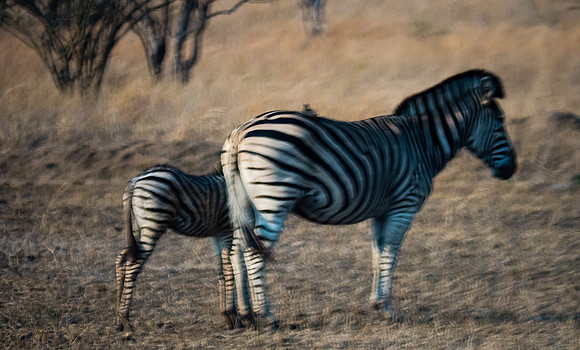
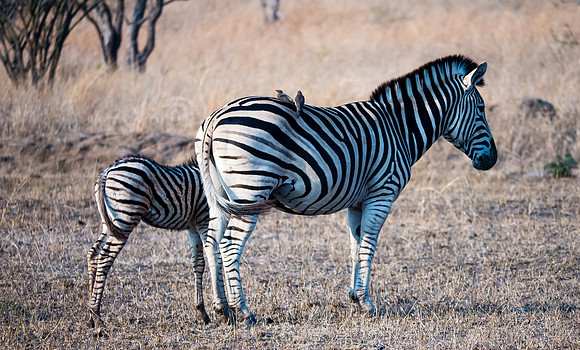
The second shot of the Zebras came out pretty well. It was at 300mm, so 600mm equivalent. I had the camera and lens on a monopod with IS switched off. But the result was still soft, and the image shown has been post sharpened in Lightroom.
During my trip, I stopped using this lens on the game drives. I spent an afternoon in camp testing it on smaller wildlife such as birds and mongoose. I still had focusing issues, but it was during this testing I noticed another problem: Bokeh. When you are zoomed in at 300mm you are at a lowest f stop of 5.6. Normally I would stop to around f8 or more for small wildlife to be sure of getting most things with the focal plane sharp. From what I saw though the bokeh on this lens is just plain ugly...
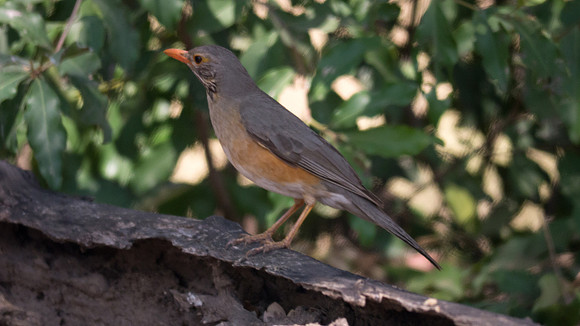
This shot is at 300mm with auto focus enabled to detect the bird. So the camera and lens have this bird as the subject locked on and in focus. Yet as you can see the bird is soft. Very soft. And post sharpening in Lightroom will not recover this image to make it useable for even the web (!). Take a look at the out of focus bokeh. You get some very strange edges and artefacts going on. It's not at all smooth and dreamy as one would like. In the example below of the same bird it looks even worse to my eye...
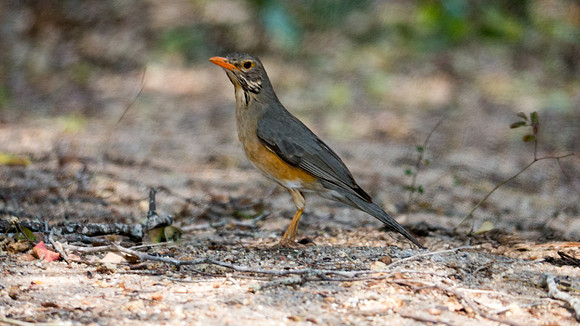
Again this is in auto focus mode, locked on to the bird...and again soft. But look at the bokeh in the top two thirds of the image. Horrible!
So, is mirrorless camera a viable option for wildlife photography? There is no doubt in my mind that the GH3, and mirrorless cameras are capable of producing stunning images, on par with traditional DSLRs. The other huge advantage when travelling is size and weight. Look at the photo below. The lens on the left is the Canon, and the lens in the middle is its micro four thirds equivalent (with the crop factor). The lens on the right is the 100-300mm Lumix lens. Both the micro four thirds lenses pack easily into a light back pack.
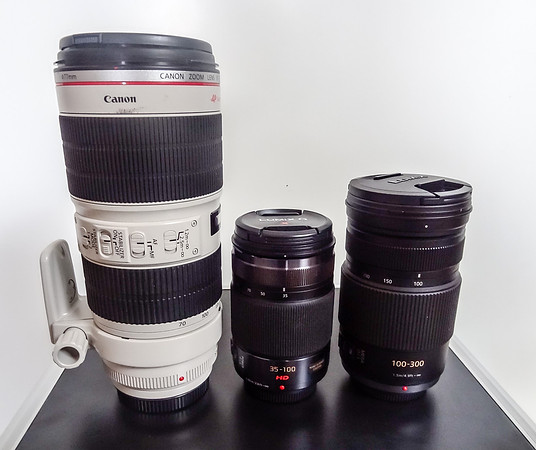
What lets the Panasonic system down today is the range of quality glass in the >200mm focal range. There is a wide range of Mirco Four Thirds glass available, but only 3 main manufacturers; Panasonic, Olympus and Sigma (with the Sigma range being more limited), and Voightlander and SLR Magic offering a range of primes. The Lumix 12-35 f2.8 and 35-100 f2.8 are outstanding lenses and the price reflects that. But there are few lens options for long focal lengths and zooms, with Panasonic offering the 100-300mm and Olympus offering the 75-300mm. If Panasonic's 100-300mm was as good as their 12-35mm and 35-100mm lenses at a similar ~€1000 price tag, then my answer would be very different. A high quality 100-300mm at €1000 and GH3 combined would give you a more than viable camera system for wildlife photography at €2000. And on price nothing could come close to that.
For now I will keep the lens, and plan on doing more testing with it to see if I can improve the results. I fear however the optics are not of sufficient quality to get high quality images at 300mm. It doesn't matter how much craft I put into it, I don't think I am good enough to beat the laws of physics!!!